Category Archives: Uncategorized

Faster

The other day I was walking down a school hallway at my normal ADD pace and I got stuck behind a woman in her late 50s. She was moving at a sort of normal, late-adult speed. That is, slowly. Unfortunately it was a long, narrow hallway, and there wasn’t room to pass without appearing, if not rude, at least rushed. I pulled out of hyperspeed and settled into a pace behind her, feeling like I was back in college driving West Virginia’s Route 20 behind a logging truck, where you can’t pass for many miles* and have to settle for 1/3 your desired speed as the truck slowly rattles through the curvy Appalacians. I wasn’t in a rush, except that I’m always in a rush. 

Suddenly a boy popped up next to me, doing the walk that kids do when running is banned. He quickly mathed the situation – the length of the hallway, the speed of the woman in front of me – and he bounded around her in a kind of ducking two-step and was off, speedwalking down the hallway. I burned with jealousy. 

Slowing my guys down is a big part of my job. Lots of my students race through homework with the same ferocious impatience as a 19-year-old behind the wheel. My students will often spend more time trying to find a shortcut than they would have just doing the actual, full assignment. In their franticness, they don’t realize is that their time-saving efforts are costing them time. 

Q: How many of my students have had the experience of rushing through a math worksheet, only to have to go back and redo a ton of questions because of dumb mistakes?

A: All. Of. Them.

There are a ton of maxims that address this – “measure twice, cut once” comes to mind – but in my experience, the one that most resonates with adolescent boys is, “Slow is smooth and smooth is fast.” 

Taming the franticness is difficult. The benefits of slowness are most readily apparent on something like a math sheet, where they fly through it and then have to go back and fix everything that’s wrong. The benefits are less apparent – and a whole lot greater – on something like an essay. Rather than slow down and think about where they’re headed, they launch in. Halfway through, they realize that their lack of a plan has yielded a nonsensical hodgepodge of paragraphs that don’t tie into an overarching thesis or thematic arc. Unlike a math problem, where they simply need to go and fix it, they’re now stuck with an essay that may take more effort to save than to just redo completely. Faced with the prospect of restarting, restructuring, or continuing to cobble together disparate ideas, one guess as to what most of my students want to do.**

Much of my work falls into one of two categories: immediate fixes and long-term change. Not getting a math concept is a quick fix: here’s how it works, let’s practice it, done. Slowing a speedy kid down is – ahem! – a slow process. The franticness is chipped away, session by session, month by month, semester by semester. I adore this aspect of my work, partially because I can relate so strongly. I still feel the furious tug of ineffective speed. It’s also one of the most fulfilling parts of my work. Like so many pairs of opposites, the excellence lies in the unification. A quick kid who can go slow is nearly unstoppable. Until they get stuck behind a logging truck. 


*unless you’re 19 and immortal. Sorry Mom!

**what is, “Cobble together?”

Leave a comment

Filed under Uncategorized

A Dog’s (digital) Life

For the past month I’ve been emailing a dog.  More specifically, a white Maltese, to whom I send homework assignments and tutoring session updates.  More and more frequently, I get a reply.

I started working with Z several months ago, and our first efforts at correspondence failed because his school gmail account wouldn’t allow the sharing of google docs.  Equally frustrating, he only ever accessed the account via his phone, meaning of course that he forgot his password and wasn’t able to log in through a computer. So I asked him to make a personal gmail account, which he did.  Well, his dad made it. And as my student is 12, and he and his dad are honest people, google required a parent password every time he wanted to access his account. Obviously that’s not sustainable. After the third time of him asking his mom to call his dad so that he could log in, we bailed on that account.

This sort of challenge isn’t unique.  Lots of my students are hampered by something technological: a firewall that prevents doc sharing, a forgotten password to an account that they only access on their phones, too many accounts and not enough passwords. Part of my job is clearing those roadblocks so that the student can actually work on the work, not work on trying to access the work.

So here we are.  Every week, when our session is over, I send an email to a new account that he created under his dog’s name.  And there’s no parental password required, as the dog is 42, going on 49. 


Leave a comment

Filed under Uncategorized

A Work in Progress

Last week I was wandering through the living room, aimless as a seventh grade boy trying to outline an essay.  That’s actually a false simile – seventh grade boys don’t outline. And it wasn’t quite aimlessness that had me roaming the house – it was confusion.  Like my seventh graders and their essays, I, too, had a clear aim. And, like them, I had absolutely no idea how to achieve it.  

We bought a house last month; the sheer, overwhelming mass of new tasks has debilitated me.  In my current 40-year-old incarnation I am an organized man, however I have found myself spinning under the enormity of my new responsibilities.  The new house, along with the joys and duties of raising a 3-year-old son and a 5-month-old daughter, have stripped away the scaffolding of organization and logistical prowess that I’ve assembled over the past twenty eight years and left me struggling to accomplish even the simplest of tasks.  I am again a twelve-year-old boy lost in the morass of obligation.

My wife finds me standing in the family room holding a pair of hedge trimmers, staring at the rug.  She suggests I go outside and trim something.  

One of the struggles that many boys encounter is having to do a little bit of a lot of things.  Twelve-year-old guys are often great at doing one thing. Think gaming, sports, hunting. Projects that have a singular goal.  Where they fall down is balancing tasks across a spectrum of responsibilities. Like…school. Disparate assignments in English, math, history, a foreign language, science confound them.  Because they don’t understand yet how each class interconnects into a larger whole, lots of boys struggle with how to do school.  

Right now all I want to do is clear ivy.  It’s incredibly gratifying and is a singular task.  I want to do it for hours on end, but instead, I can only do it in small stretches, in the cracks and gaps of my full, chaotic life.  My ivy work is interrupted by the calls to the utility companies, the ordering of furniture, the desperate cries of a baby, the screaming joy of a toddler, the procurement of food, the coordination of contractors (by my experience, men who enjoy work with a singular goal), and, of course, the gainful employment that makes it all possible.  

My to-do list grows a bit more every day and, frustratingly, I have crossed off very few items.  That’s because I’m somewhat or mostly done with a lot of them, but not all the way done. Enter long-term projects.  This is the Achilles heel of most of my students. They want to do all of it all at once, which most of the time is impossible.  Making incremental progress over a span of two or three weeks doesn’t come easy. So most of them save it up for the last day, and with the famous exceptions of Matt Stone and Trey Parker, that approach doesn’t work very well.  To fight this, I have my guys lay out their list of tasks, how long they’ll take, and when they’re due. Once these are on paper, stress tends to drop because the boys can better wrap their heads around the work to be done and, when each piece is complete, they can cross it off the list.

Like my twelve-year-olds and their projects, I just want my house done.  The landscaping set, the basement organized, the mirrors hung, the windows cleaned, the bookshelves built, the new lighting installed, the porch stairs redone, the window screens fixed, the locks changed, the French drain built, the this, the that, the other all complete.  This will never happen, obviously.  Life is a work in progress with an unannounced due date.  But like my guys, I’ve made a list of what I need to accomplish, how long I think it will take, and it’s priority level.  And, like my guys, I’m slowly checking things off.  

1 Comment

Filed under Uncategorized

Keys Wallet Cell Phone

When I was 24 I ran an after-school program for elementary kids in the East Bay. My co-director Jen and I would close up every night around seven, the September sun still burning through the smog and the Concord heat still clinging to the empty asphalt. Every night around 7:30 I’d return to pick up either my wallet or my cell phone, which I’d forgotten in the drawer of my desk. If it was my keys that I’d left, and Jen had already roared off for home, I would track down the night janitor and beg him to break protocol and open the office door for me. When he wasn’t around or was feeling unhelpful, Jen got a phone call.

For the first month my co-director took mild amusement at my forgetfulness; by October, she’d crafted a plan. “Keys-wallet-cell phone, keys-wallet-cell phone” became her new mantra as we turned off the final lights and prepared to lock the office. I’d pat down my pockets: front right – keys. Back left – wallet. Back right – cell phone. “Check!”

I didn’t forget them again.

These three simple pats have stuck. The days of me forgetting almost everything are over, but I still pat down my pockets every time I walk out of my house, or leave a tutoring session, or head home from the gym. Sometimes I can hear Jen’s voice, friendly but tinged with mocking. Keys. Wallet. Cell phone.

A decent number of my students are forgetful, but only one gives younger me a run for my money. I ask to see his assignment planner, but he’s forgotten it. He couldn’t do his math homework last night because he left his book at school. He’s got reading to do, but….where is that book?

So I crafted a plan. Every day as he leaves school, his mom will ask him this question: Do you have your M-BRAN? It’s going to change his life.

M – math book?
B – binder?
R – reading book?
A – assignment planner?
N – notebooks for reading and writing?

This was a simple system to create. I asked him what materials he needs to do his homework, and then I arranged the letters as best I could. Sometimes he doesn’t have math homework, or need his reading notebook. Doesn’t matter – it stays in the acronym. In the beginning I’ll have him bring home everything, every day. As he gets more self-aware and stops forgetting materials, he can scale back and only bring what he actually needs that night.

This sounds like more work for the kid, right? Nope. When I explained the new system, a look of deep relief spread over his face. We practiced the acronym several times until he knew it by rote. M-BRAN, M-BRAN, M-BRAN.

At the end of our session he happily walked me to the door. He usually does this, but there was extra spring in his step. He now had a system, a way of doing something every time that would create consistently excellent results and didn’t require him to remember anything other than a word. A simple acronym for all that he needs to bring home frees him from the frantic, chaotic searching of his mind and organizes his approach into a clean, methodical checklist. If all checks out, he’s good to go – and he knows it.

He opened the door and held up his hand for our usual high-five.

I slapped it. “M-BRAN!”

He giggled. “M-BRAN.”

I walked out into the cool San Francisco night, but not before checking my pockets. Keys. Wallet. Cell phone.

1 Comment

Filed under Uncategorized

Executive Non-functioning

For some forgotten reason, during my sophomore year in college I ran for and was elected secretary of my fraternity. This was a bad idea on my part and a massive miscalculation on the part of my fraternity brothers, who assumed that as a college student I possessed the ability to carry out official fraternity business, deadlines and all. That was the year we almost lost our charter. At the end of my term the representative from our national office paid us a visit. He was not thrilled, and wanted to know why we hadn’t turned in any paperwork for either of the last two semesters. (Thankfully I hadn’t been elected treasurer.) Standing in my disheveled, Bob Marley be-postered room, he asked to see my files. I didn’t have any.

It wasn’t a common diagnosis back then, but I suffered from severe executive functioning inability. Most of my students have a similar bent. Their backpacks are where important papers go to die. Spoons, crumpled field trip permission slips, bits of string, tennis balls, creased algebra quizzes, rotting orange peels, and broken pencils all collect and coalesce on the bottom. Their binders contain the mysteries of middle school – assignment sheets they didn’t know existed, grammar notes from seven months ago, handouts that have been liberated from the constraints of the 3-ring system and have been optimistically stuffed somewhere within the beaten covers, sandwiched between yesterday’s missing homework and tomorrow’s forgotten study guide.

Executive functioning covers a broad range of activities, but in my experience the two most challenging areas for boys are maintaining an organized life and planning out their assignments. These behaviors are changeable, but it’s not easy. The bad news is that, if left unchecked, many boys don’t figure this out until they’re men – if ever – and at that point it’s not called poor executive functioning, it’s called not having their shit together.

The good news is that most guys can benefit from immediate help in these areas – help which you can provide. In the educational world, we call this “scaffolding.” In the regular world, we call this “doing it for them until they can do it themselves.”

Your basic job is to fight entropy, whether caused by laziness or inability. Here’s how.

An Organized Life. This consists of backpack, binders, pencil case, locker, study space, archive binder, and home study supplies. It is a rare middle school boy that can handle all of this on his own. You can help by making sure these are in order. It’s a bit like how I imagine a military inspection, or at least how it’s portrayed in Stripes. Organization checks should happen at least once a week. A word of warning – as you probably know, your middle or high school boy won’t be happy about you auditing his stuff. This is why I have a job. Developmentally, it’s better if this can be done by a man who holds some authority (father, uncle, etc.), rather than a woman, but having it done by mom is much better than not having it done at all.

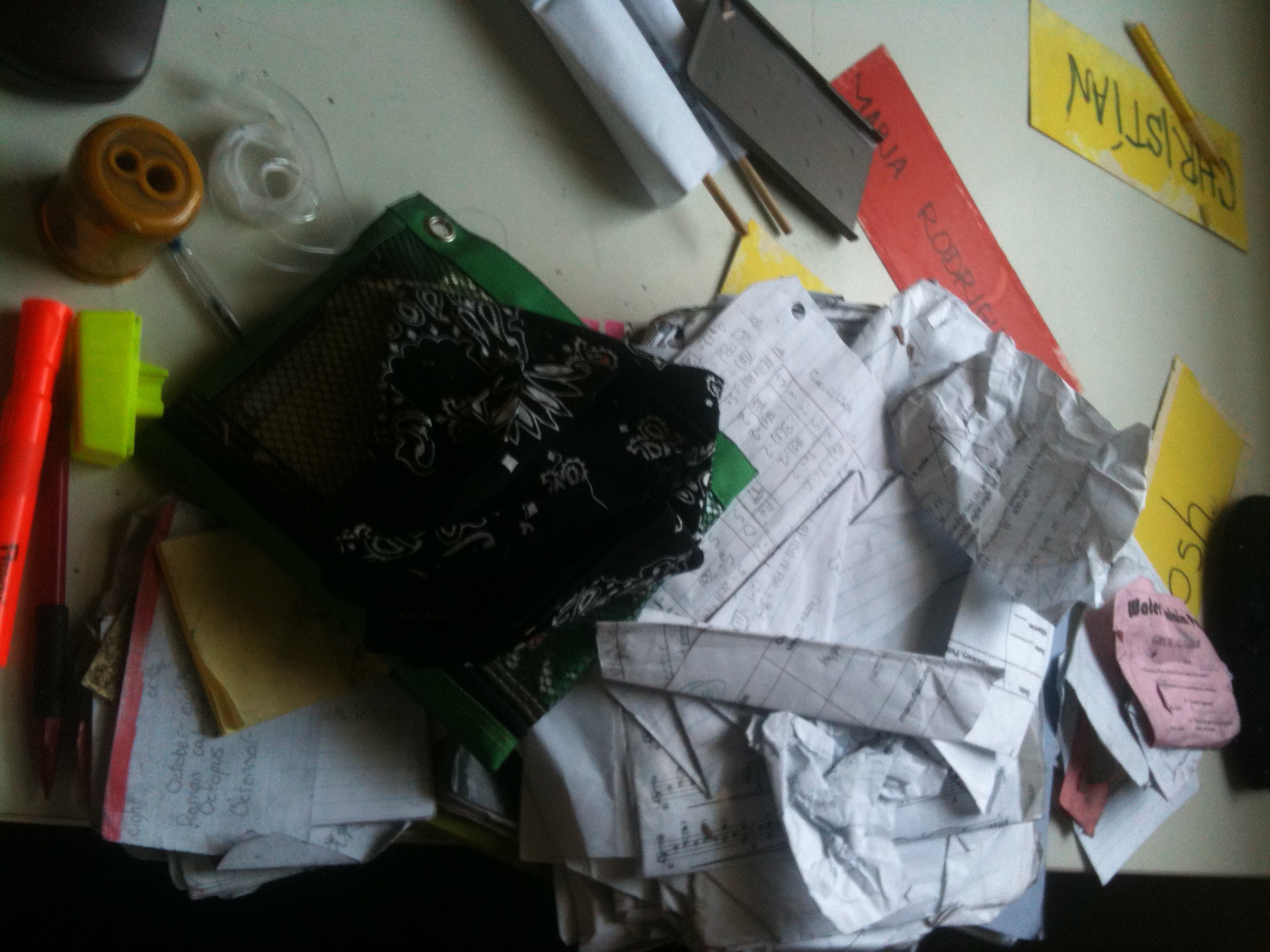
Backpack: Empty completely – all books, binders, other crap. Loose writing utensils go in the pencil case. Now’s a good time to do the binder check. All other trash/important papers/old food/singleton socks should be handled accordingly.  The first time I check a student’s backpack, it often looks like this:

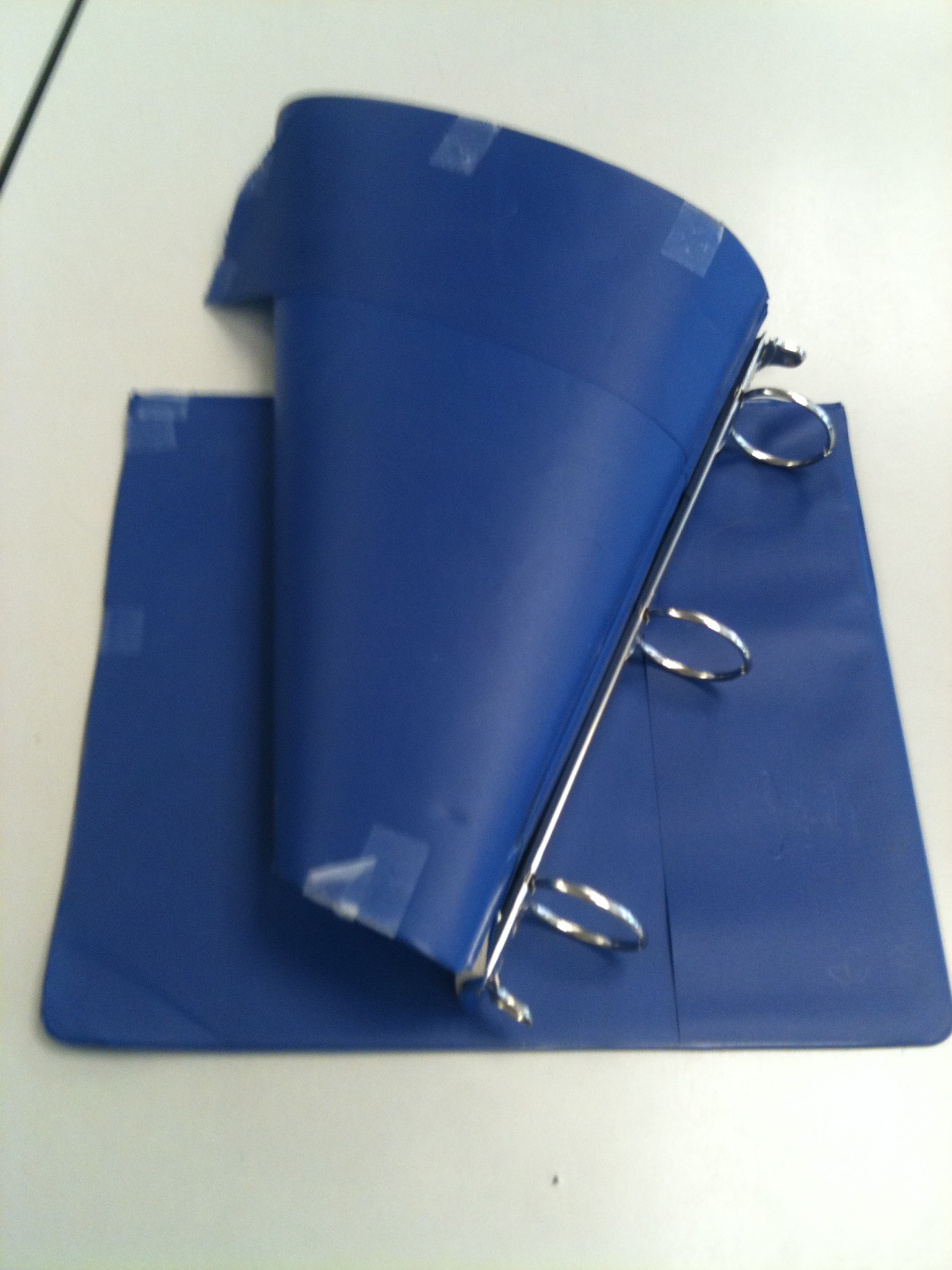
Binder(s): If single-subject, should be 5 tabs unless otherwise specified by the teacher. These are: Homework, Notes, Handouts, Quizzes/Tests, and Paper. For most subjects, either 1-inch or ½-inch is good. If multi-subject (not acceptable for H.S.), then there should be tabs for each subject. Avoid pocket tabs, which allow students to stuff papers into a pouch. All papers should be 3-hole punched and filed in the right spot. If some papers need have their holes reinforced, reinforce them with binder reinforcers; it just takes a minute. In the absence of binder reinforcers, scotch tape and a 3-hole punch will do. Refill lined paper if it’s low. Archive old, unnecessary papers. Binders should have front and back pockets, but those shouldn’t be overflowing – a few recent papers are fine, but nothing ridiculous. Avoid broken, breaking, torn binders – toss and get new ones. I like single click openers best, but just stay away from the cheapest ones. The minute a ring starts to fail the binder is useless, because it’ll just start ripping up all the pages and making school life hell.  Avoid this:

Pencil Case: Some students want to have a pencil case in each binder. This strikes me as overkill and redundant, but whatever works. I usually recommend one that stays in the backpack. It should have pencils, pens, pencil sharpener, erasers, white-out, glue stick, small scissors, a few rubber bands. And not 25 pencils and 15 pens, nor 2 pencils and a single pen. Shoot for 5-10 of each. When you check this, toss pencils that don’t have erasers – literally break them and throw them away. I know, shame. But they’re a waste of space, and Ticonderogas are 15 cents a pop: get over it. Sharpen dull pencils, check pens for ink, replenish supplies as needed.

A Clean, Well-Lighted Place to Study: This is a point of contention among most of my guys. My rule, which they don’t like, is that studying in the bedroom is not allowed. Or at least it’s highly discouraged. That’s where all the distractions are, and there’s also less chance of being caught screwing around, which encourages screwing around – or at least doesn’t discourage it. Dining rooms, kitchens, the study/den, wherever there’s a good flat surface and relative quiet is fine. It’s your job to respect this space and prepare it for your student.

Archive Binder: This lives at home. It’s a large binder (2 or 3-inch), tabbed out to cover each subject. For high schoolers, you may need two. When units are done and no longer referenced, rather than throwing them out or letting them take up space in the binder, archive them. Chances are they’ll never be needed, but if they are – there they are. Basic rule is never throw out any school paper, just archive it instead. A good place to keep this is with the home study supplies.

Home Study Supplies: This is similar to the pencil case, but better. It can be in a nearby cupboard, a box (especially good if you have a two-household family), or a drawer – just make sure that all the supplies are in one spot. They are: scissors, 3-hole punch, binder reinforcers, lined paper, blank printer paper, sharpie, pens, pencils, erasers, binder clips, rubber bands, dictionary (small is okay until college). The basic idea here is that home is base camp and school is the wild. Replenish at home for the chaos of school.

Locker: Yup, this one’s the hardest. Few middle schoolers are eager to bring their parents to school and show off their locker organization. Teachers and tutors are excellent in this regard. Locker checks don’t have to happen as frequently, but if your kid is really disorganized, get it done. The low maintenance way is to give your child a duffel bag and tell him he needs to put everything from his locker in it at the end of the day (just on locker cleanout day, not everyday). Then you can go through it and take out all the crap in the comfort and privacy of home, rather than in front of his peers. The high maintenance way – trucking down to the school and laying out the locker contents on the hallway floor in front of all his friends – is a good deterrent and should reinforce the benefit of the low maintenance way.

Leave a comment

Filed under Uncategorized

Cards

When I was a camp counselor for 12-13 year old boys during the summers, I’d host epic blackjack tournaments in our cabin and let the boys wager candy that I had distributed to them. They’d want to eat it right away, but that universal pull would give them pause: If I bet it, I could win more. Adolescent boys are purveyors of hope; they always bet. And despite the eventual victory of the house/cabin, those evening tourneys were often the highlights of camp. Other counselors would come to join and egg-on the boys. “One tootsie pop?! You gotta bet big to win big, fellas!” Though teaching math principles wasn’t the goal, I’m sure the boys took home some valuable lessons in probability, as well as improbability. “Sure, 19’s a decent hand, but what if the next card’s a two?”

In my tutoring work, the cards have carried over. Most boys love competition, and cards help bring that feel. I carry a large Indiana Jones-like satchel, which I keep stocked with pencils and pens and those stick-on binder hole repair circles, but really the main value in the bag is my deck of cards and my pack of gum.

Here are the various games I use and the skills that they hone, in ascending order of at-home benefit:

Flashcards (addition, subtraction, multiplication)
This is not a game, just flashcards using a deck of cards. Why buy a deck of flashcards that isn’t good for anything else when a deck of cards works just as well? I throw down two cards and the student adds or multiplies them out. If they get one wrong I’ll help them, then come back to it after they get some other ones right. It’s an intense workout, so I usually just do it for 5-7 minutes (which may be several runs through the deck).

Slapjack (addition, subtraction, or multiplication)
This game is all reflexes. Players put down cards on top of one another in quick succession. Any jack gets slapped, as does any pair. Whoever slaps first wins the pile. The twist I use is adding a slap for any two consecutive cards that add up to a certain number (like 9), subtract to a certain number (like 3), or multiply out to a certain number (also a nice way to teach factors if you choose a number with multiple sets of factors (24, 40, 48, etc.)).

War (subtraction)
Simple and fast. The twist here is that whoever wins has to say how much they won by. Jacks count as 11, queens as 12, kings as 13, and aces as 14. So that the kids stay sharp, I’ll mix in some subtracting mistakes when I win.

Cardslam (addition, subtraction, or multiplication)
Okay, I made this one up. It’s a stretch game-wise, but great for building speed. Just like war, except nobody wins cards – the players just say what the two consecutive cards add/subtract/multiply to. Student puts first card down, I put second and say whatever those two add up to (or multiply/subtract). Then he puts down his next card and says what the top two cards add up to. Repeat, with speed.

Difference-Sum-Product (subtraction, addition, multiplication)
I made this one up, too. It’s not really a game, per se, however most kids get into it and want to do it fast. And I want them to do it fast, too. Throw two cards down (no face cards), and the student shouts the difference, the sum, and the product as fast as possible. This builds automaticity, but it’s also a nice background for factoring once they hit 8th grade.

21 (addition, subtraction, probability)
I love this game for addition and subtraction. It’s also fairly disguised learning, so this is a good one for home when the student doesn’t think he’s actually “learning”. Asking questions deepens the results. “What do I have showing? So what’s the best card for me to have in the hole?” It also prepares them for the cruel, cutthroat world of camp.

Cribbage (addition, subtraction, probability, logic, strategy)
The crown jewel. Cribbage is such a good game for math that I convinced a local school to allow me to teach it as an enrichment class. The boys love it. This is disguised learning at its best and great for a family game. It’s fast-paced, fun, and has simple rules that allow for deep strategy.

Leave a comment

Filed under Uncategorized

The Catching Machine

I’m not all tutor. I’m part big brother, part friend, part cheerleader, part teammate.

One of my students needed to imagine a machine and write about how it would serve a need. The kid’s a great kid – smart, hard-working, courteous, but beyond all that, good. The kind of kid you’d want your kid to be. He’s got great parents, but like most fathers his works a lot. His younger siblings are too young to play ball with, and his mom’s….well, his mom. So Dan invented a catching machine.

It’s big and broad and has eight arms. It catches fastballs, curves, sliders. It’s got legs and brings in long, arcing spirals down the sidelines. I suppose it can dribble and shoot, but it can definitely pass. It doesn’t tire and is available every afternoon after school.

I was raised by a single mom; I had a catching machine too. Mine was the garage door, and in the center of the chipped baby blue paint I had crafted a 2’x2’ square – a tattered, masking tape strike zone. The pitching mound was the edge of the speed bump that slowed our apartment complex traffic. I served as the entire pitching staff. I opened, relieved, and – my specialty – closed high-pressure games with down-to-the-wire, clutch performance. I was Brian Wilson before Brian Wilson was Brian Wilson.

I handled the infield, too. At third I’d backhand one-hoppers down the line and hurl them across the diamond with major league accuracy – to myself, waiting with outstretched legs and a glove that never failed. If a mean grounder threatened to break through with a man on first, somehow I’d glove it, give a sweet underhand toss to second for the force, and wing it to first for the double.

Sometimes Dan and I play catch. We’ll toss a football as I quiz him on whatever it is that needs quizzing. Memorizing poems is aided by catch. Discussing debate topics for humanities is aided by catch. We throw the football across the classroom as we shout out multiplication tables.

“Eight times seven.” A hard, tight spiral to Dan’s right.
He snags it and wings it back. “Fifty-six!”

And this, too, is high-pressure: one errant toss or missed catch and something gets broken. We silently acknowledge this and respect the pressure.

Most days I like my job. I help boys grow into competent, confident, intellectually curious young men. Some days I’m a math tutor, some days a giver of advice. Some days I’m an editor going over the finer points of our English language, and some days I correct poorly drawn Chinese characters. When it’s needed I’ll share my own history of struggles in school, or lend the needed energy and encouragement in the final throes of a brutal assignment. But some days I love my job. Some days I’m a catching machine.

Leave a comment

Filed under Uncategorized

The Joy of Test Prep

The year I took my SATs the Spice Girls topped the charts, Cuba Gooding, Jr. shouted, “Show me the MONEY!”, and Ted Kaczynski became a household name. That was also the year we upgraded to a 28.8 modem to better navigate the information superhighway. Oh, AOL….

And of course there were the events not destined for our cultural timeline – first love, epic varsity wins, wisps of facial hair (finally!), speeding tickets. There wasn’t much time for SAT prep. Besides, only kids who did poorly had to study. If it wasn’t broken, why fix it?

Our timeline has clicked onward. The Spice Girls are staring at 40, most of Cuba’s work goes straight to DVD, and The Unabomber is serving life without parole. That superhighway has exploded to unthinkable proportions: “Roads? Where we’re going, we don’t need roads.” And nobody blows off the SAT anymore.

In fact, for many students the SAT is the second high-pressure test they’ll take to gain entrance to a prestigious 4-year school. The first is the SSAT – the Secondary School Admission Test.

The pressure surrounding this test can be intense, and is both unfortunate and unfair for the 8th grade students who have to take it. However, there are some marked benefits to the test prep – especially for middle school boys – that can bring some silver lining to a process that feels both developmentally inappropriate and increasingly insane.

Many boys, and this is particularly true for the more intelligent ones, have not developed methodologies for handling the complex academic tasks that they’re asked to do. They’ve been coasting on talent. They don’t know how to study, how to craft an approach to multi-step assignments, or how to persevere through not understanding a concept and work at it until they do. Test prep nicely handles the first and the third of these issues; not so much for multi-stage assignments, but you can’t get everything.

There are five sections on the SSAT. The writing section is the only one that is not graded, however the essay is sent along with the scores to the school to which your student is applying. Here are the sections, the methods to employ, and how they help improve student performance outside of the test.

Writing Sample – 25 minutes
This is typically one of the most baffling sections for students, and therefore the one with the largest potential for student improvement. Usually students are given a prompt, such as “Imagination is more important than knowledge” or “The apple never falls far from the tree.” They’ve got to interpret the quotation and show whether or not they agree with it. Every now and then they’re asked to explain the most meaningful moment of their lives, or something equally open-ended.

The break-down is this: Introduction should have a hook, an explanation of what the quote means (even if it’s stupidly obvious), and their opinion. Next come the four pillars on which to draw: Arts, History, Self, and Community. Ideally, students should come up with an example for each of these that supports their claim. If four is too much, three will suffice. Arts draws on books, plays, poems, or movies, though that’s the tourniquet option. History is history. Self is about them – personal examples from their own lives that have informed their opinions. Community is more broad. This can be a tight community like soccer, or a larger community like the US (current events would fit into this category, as would family). The conclusion should reference the supporting evidence. The closing sentence is the most important sentence in the essay.

I have my students outline their responses to practice prompts by creating a large square with the four areas, then filling them in. They also write their interpretation, opinion, opening sentence, and closing sentence. Initially I’ll give them 25 minutes to make one. Then we move to 20. Then 15. Then 10. I encourage them to use 10 minutes on the test to create their outline. The takeaway here is that preparation is everything. Great outlines make the writing easy and the process fun. Employing a structure focuses the students and frees them up to work on actual ideas, rather than floundering about for some thread of coherence.

Math – 2 sections (which are different)
Both sections have the same principle – do as little math as possible. This means eliminating answers BEFORE real math is done.

Quantitative Reasoning – 25 problems, 30minutes
This is basically a section of word problems. Some are easy; some are not.

If Sam can do a job in 4 days that Lisa can do in 6 days and Tom can do in 2 days, how long would the job take if Sam, Lisa, and Tom worked together to complete it?
a) 3.2 days
b) 1.09 days
c) .78 days
d 1.98 days

My favorite students are the ones who wonder, “What random, unnamed job is this? Why are they working together? If they are working together, maybe they’re distracting each other and now they’re even slower than if they were working alone. Wouldn’t Tom resent Lisa for taking three times as long? Or would Lisa resent Tom for making her look bad?”

The SSAT is a hard test, but a simple one. (Answer: 1.09 days, or 12/11 of a day. Answers “a” and “d” should be eliminated immediately because if Tom can do it by himself in 2 days, with help he’ll get it done faster.) There is no room for thinking outside the box. I tell my students that in life, those questions are vital; on this test, they’re crippling.

There are too many math techniques involved in this section to explain, however the overarching principles are: draw diagrams, figure out what the question actually is, and eliminate obviously wrong answers. A mantra that I use for both math sections on the SSAT is this: There’s no math in math. The intent here is to get the students in the habit of working most efficiently to answer the question. This is different than solving the problem. Once all wrong answers are eliminated, the remaining option must be the right one. Trust in Sherlock Holmes and move on. The lesson on quantitative reasoning is how to determine the actual question and move towards the answer in the cleanest, most efficient way.

Calculations/Arithmetic – 25 problems, 30 minutes
If your student gets to use a calculator (as an accommodation), this part becomes much easier. For the rest of us, it’s just working out the math. Example:

Which of the following is less than 2/3?
a) 6/9
b) 3/4
c) 5/8
d) 7/10

This section is part intuitive, part math. If they’ve been working on fundamentals (and they should have been), answers “a” and “b” get ruled out immediately. 6/9 is equivalent to 2/3, and noticeably so. 3/4 is higher and again, noticeably so. That leaves 5/8 and 7/10. This is a tricky question because neither of the remaining answers are easily converted with 2/3 (4/9 would be – 2/3 becomes 6/9, and we only had to change one fraction, rather than both). So because there can only be one correct answer, it follows that the lowest one is the correct one. Now the question becomes “which is lower – 5/8 or 7/10?” Getting inside fractions with fundamentals is important, because most of my guys should know right away that 5/8 is lower. (They should know this because 5 is three away from 8, and 7 is three away from 10, and 7 is higher. That concept is easier to see in extremes – which is larger, 1/4 or 997/1000?) Note that we answered this question without converting a single fraction. There’s no math in math.

Here’s the wrong/laborious way to do this problem:

Compare all fractions by converting to common denominators and you get:

a) 6/9 vs. 2/3 becomes 6/9 vs. 6/9
b) 3/4 vs. 2/3 becomes 9/12 vs. 8/12
c) 5/8 vs. 2/3 becomes 15/24 vs. 16/24
d) 7/10 vs. 2/3 becomes 21/30 vs. 20/30

C is the only one that is less than the modified 2/3. The reason this is poor form is that it requires converting 7 fractions into equivalent fractions (6/9 doesn’t need to be converted). For some students, this would have taken 5 minutes, or more.

The take-away with calculations is that so much of the mental math that’s required on the test – and in daily life – can be made easier by logical thinking, obviating the need for complex calculations. Again, there’s no math in math.

Verbal – 60 questions, 30 minutes
This section consists of 30 synonym and 30 analogy questions. The basic strategies are similar: cover the options and write the answer, then match up the written answer with the options given.

Synonyms
These utilize the least technique – they either know the word or they don’t. If they do, they write what it means and check out the given answers for the best fit. If they don’t know the word, they circle it and come back to it. Later, they’ll scan for roots and prefixes, and try to remember if they’ve heard it in context. If they can eliminate at least two wrong answers, they should guess.

Analogies
Dawn is to Dusk as ….
…Begin is to Finish

That one was easy, but they get much harder.

Threat is to Hostility as….
a) plea is to clemency
b) promise is to benevolence
c) lampoon is to raise
d) capitulation is to malice
e) compliment is to admiration

Strategies: cover answers, come up with a “linking” word or phrase that joins the analogy given, and use that in each of the options, eliminating the faulty ones.

Threat is a “way of showing” hostility as
a) plea is a “way of showing” hostility — NO
b) promise is a “way of showing” benevolence — not quite, maybe I’ll keep it in contention
c) lampoon is a “way of showing” raise — doesn’t even make sense
d) capitulation is a “way of showing” malice — nope
e) compliment is a “way of showing” admiration — that works well.

The take-away with this one is that there is often a structure we can put over seemingly unstructured problems. This mirrors school well, because there are so many easy tasks (like easy analogies) that don’t require sound structure, but it really pays off when faced with legitimately tough questions.

Reading Comprehension – 40 questions, 40 minutes
I am not alone in liking this section least. I’ve struggled to find a real-world application for the skills that this section requires, and the best that I can do is that it reinforces the benefits of a structured approach, and that the inference questions require solid reasoning skills. The rest of it I find useless, but since it’s not going away, here are some tips.

Break questions down into 5 types:
M – Main idea
D – Detail
V – Vocabulary in context
I – Inference
T – Tone
and practice labeling questions. On the test (and in practice), questions should be labeled (M, D, V, I, or T) before the passage is read. If a passage looks too hard, skip it entirely and save it for last. The same holds true for certain types of passages that the student identifies as consistently frustrating (poetry comes to mind…..).

Main idea questions often ask what the best title of the piece would be, or what is coming next. I ask my students to title the piece after they read it, which helps them think about the main idea.

Detail questions ask specific questions about some aspect of the text, like “according to the text, which of the following are not amphibians?” A scan of the text should give an answer, and it requires no reasoning.

Vocabulary questions are often the easiest. A word will be used in context, and the question will ask what it means. I have students circle unknown words when they read so that finding the word will be easier.

Inference questions can be tricky. These require students to draw on their own knowledge base to make conclusions. Reasoning is huge for these, and it takes practice. Practicing different ways of eliminating wrong choices is the best way to path to success.

Tone questions relate to the author’s tone, and can sometimes be confused with inference questions. “The author believes…” is an example of a tone question. The key here is looking for adjectives that identify a point of view or bias, like “in her masterful painting…” or “Though Germany was wrong…”

And that’s it, end of test.

Most of my students end up enjoying the prep process, partly because I try to make it fun, but mainly because they can receive direct feedback on how their hard work is paying off. As they start to get good at the methods, their scores rise. They get good at the test, and being good at stuff is fun.

Leave a comment

Filed under Uncategorized

Fail Better

Ever tried.
Ever failed.
No matter.
Try again.
Fail again.
Fail better.

– Samuel Beckett

I have two rules: bring your A-game, and fail. Fail better, fail harder, and fail more frequently. The first rule is easy. Few adolescents lack heart when properly motivated; they almost always give me their all. It’s the failure that’s so hard.

Recently 60 minutes aired a fascinating episode on face blindness, which is an inability in certain people to recognize faces. The reasons why some people lack the ability to distinguish faces is still unknown. Nancy Kanwisher, a Professor of Neuroscience at MIT, gave brain scans to a group of face blind people to test her hypothesis that the problem lay with the Fusiform Face Area.

She sat across from Leslie Stahl and explained her results.
“I really did not expect to see a Fusiform Face Area.”
“So you thought there’d just be nothing there.”
“That’s right. And we looked at the data, and the face area was beautiful – it’s textbook.” Professor Kanwisher smiled, broadly. “But see, that’s the fun of science. It’s fun to be told you’re just completely and totally wrong. Because now you have to go back and think anew.”

This is not a perspective most students enjoy. Our current culture discourages failure. We’re expected to be perfect right out of the gate, free of mistakes, blemishes, and missteps. Society views failure as an unwelcome destination, rather than a temporary state, and I see that message clearest in one of my 6th grade students.

Richard hates math, or rather, he hates failing at math. When I started working with him a year ago he was frustrated, disorganized, and pretty awful at math. Now he’s frustrated, organized, and much better at math. Last semester he pulled a 98%, which surprised even me. His math teacher hugs me when I see her and, though Richard still struggles with concepts, we work through them and he ends up understanding. But his frustration remains.

So where do we go from here?

My goal for Richard is not a 98%, or a solid understanding of linear equations, or even a love for math. It’s for him to discover concepts on his own – to attempt and fail and attempt again until he’s failed so many times that he gets it right. Once he’s got that he won’t need me anymore and I can move on to some other kid with a disorganized binder and a misorganized mind.

But how do I get him there? How do I teach him that failure is not a permanent state?

I’ve tried working the lessons into hacky sack, one of our break-time activities. Like everything else that he does, his threshold for hacky sack frustration is limbo-low, and despite never practicing he expects to be expert at what is a difficult activity. I prodded him on the challenges of the game while our uncoordinated feet flailed, asking him how he might improve. That bit of life coaching didn’t work; all it did was kill the feel of break and give him even more pressure to excel.

I’ve tried helping him connect the dots through meta-cognition – talking about how his failures have added up to successes in a repeating, reliable pattern. That, too, has been unsuccessful.

This is not a column about my success teaching Richard how to fail. What I’ve done so far hasn’t worked. He’s getting much better grades, so that part is going well, but in terms of my goal to help him embrace temporary setbacks on the path to greater understanding, I have failed. He’s told me that he still hates math and that he doesn’t really understand.

But see, that’s the fun of teaching. It’s fun to be told that what I’m doing isn’t working, because now I have to go back and think anew. And I’ll probably fail again. But eventually, I’ll succeed – and he’ll get the hang of failing.

Leave a comment

Filed under Uncategorized

The Gift of a D

One spring morning in 1991, my mom marched down to my middle school, a recently graded essay of mine in hand. She smoothed out the essay before the teacher, commented on the lack of red marks, and demanded to know why it was given a “B”. It should have earned, in my mother’s expert opinion, no more than a “D”. The teacher was shocked, confused, and then won over. The following week, at my mother’s request, I got my D.

This is not a contemporary problem.

Marin in the early 90s was one of the breeding grounds of helicopter parenting, following on the heels of the soccer mom phenomenon. I’d been given a good grade on a bad paper because the teachers had lowered standards to accommodate the increasing barrage of complaints from parents whose brilliant children were not receiving straight As. This was 20 years ago. It’s now worse.

In her informative and cautioning book A Nation of Wimps, Hara Estroff Marano describes the new generation of helicopter parents. The hovering is done; they now bulldoze. “Lawn mower” or “snow plow” parents attempt to smooth over obstacles for their children on the almighty quest to attain Ivy League acceptance. Marano argues that this smoothing over, rather than aiding, is actually preventing the development of emotionally stable, competent, intrinsically motivated young adults. The elimination of obstacles instead produces fragile, risk-averse adult children incapable of solving real-world problems.

Dr. Leonard Sax makes a related argument in Boys Adrift, attributing some of the modern young man’s apathy to a lack of concrete challenges – and failures – due to overprotective parenting. Lack of failure negatively insulates boys (and girls) from life and its many vicissitudes, but it also robs them of life’s greatest joys. As Aldo Leopold wrote, “Of what avail are 40 freedoms without a blank spot on the map?” Parents who eliminate obstacles also eliminate possibilities. They pave over the crevices of life where inspiration and serendipity dwell, and much is lost in that paving.

When I begin work with a new family, I make it clear that grades are not a top priority. In fact, they’re not even in my top three. My priorities when working with a student are work ethic, organization, and passion for learning. When these three are in place, good grades follow.

I’m ill-suited to give parenting advice, as I’m not a parent. However, I do know that strength is inherent in humankind, and that like anything, it grows with use and atrophies without. We’re a hardy lot; we can handle failure. But more than that, we deserve the very thing that makes this life worth living: surprise.

My middle school life has irretrievably faded into an increasingly jumbled past. The 90s, for better or worse, are gone, replaced by a time of excitement, confusion, and a future unknown. And now, as an adult navigating the real world and its real problems, I’ve never been more thankful for that D. Surprise and all.

Leave a comment

Filed under Uncategorized